Unflattening
written by Nick Sousanis

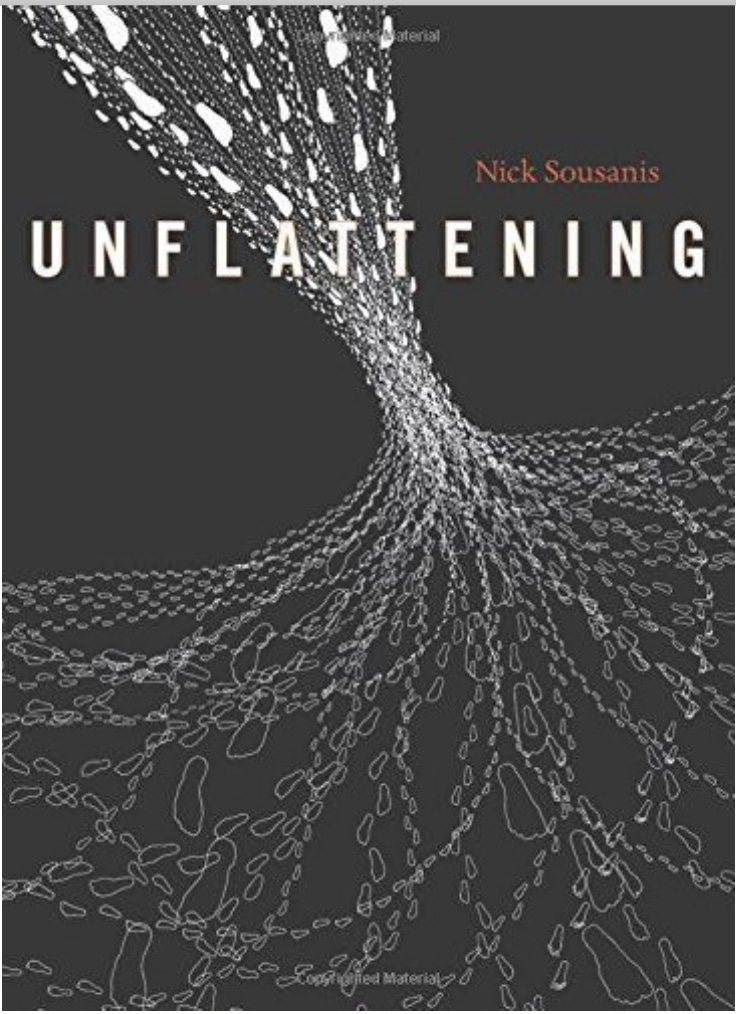
Unflattening
written by Nick Sousanis
Cambridge, MA: Harvard University Press, 2015, 208 pages ISBN: 0-674-74443-8 (paperback) Price $22.95
With their striking images, rich colour, epic themes, and infinite sense of possibility afforded by a form that has few formal restrictions, comic books speak to many students. Post-doctoral fellow Nick Sousanis has leveraged the innate malleability of this genre and moulded comics in his own unique way. He has shifted their subject matter from one that has mainly been the province of larger-than-life characters in fantastic situations to the more sedate realm of academic discourse. His doctoral dissertation has been transformed into the book Unflattening, and it is a welcome addition to the comic lit canon. The book takes an analytical slant on comic books and deepens the subject matter they normally explore. For those interested in other seminal books in this genre, Unflattening is a worthy successor to Scott McCloud’s groundbreaking book Understanding Comics (1993), an integral primer that introduces the complex visual language of comics. Eschewing the more popular, generalist subject matter addressed by McCloud, however, Sousanis travels much deeper into more traditional academic terrain, grounding his work in existentialist exploration.
In its purest and most essential form, Unflattening primarily concerns itself with the unfortunate tendency of the quotidian demands of the world to ‘flatten’ us. These duties and requirements cause people to adhere to patterns of one-dimensional thought and action (Marcuse, 1991). In a late-capitalist society where a neoliberal ideology has taken control, there is a tendency towards measuring and recording, homogeneity and conformity, commodification and dehumanization. In Sousanis’s parlance, these market imperatives have caused us to be flattened—our thoughts, perceptions, and actions lose their transformative potential to transcend the mundane nature of much of our daily existence. Due to the busy nature of our lives, it is difficult to muster sufficient time and energy to gain a critical perspective on them. As a result, it becomes a significant challenge to escape the confining limitations of our present state. By exploring these ideas in his publication, and by integrating his poetic text and intricate visual styles, which vary widely depending on his rhetorical intent, Sousanis makes a convincing argument for the visual to be given equal status to the textual in academia. This is an ambitious agenda, but one that he confronts with vigor and elan.
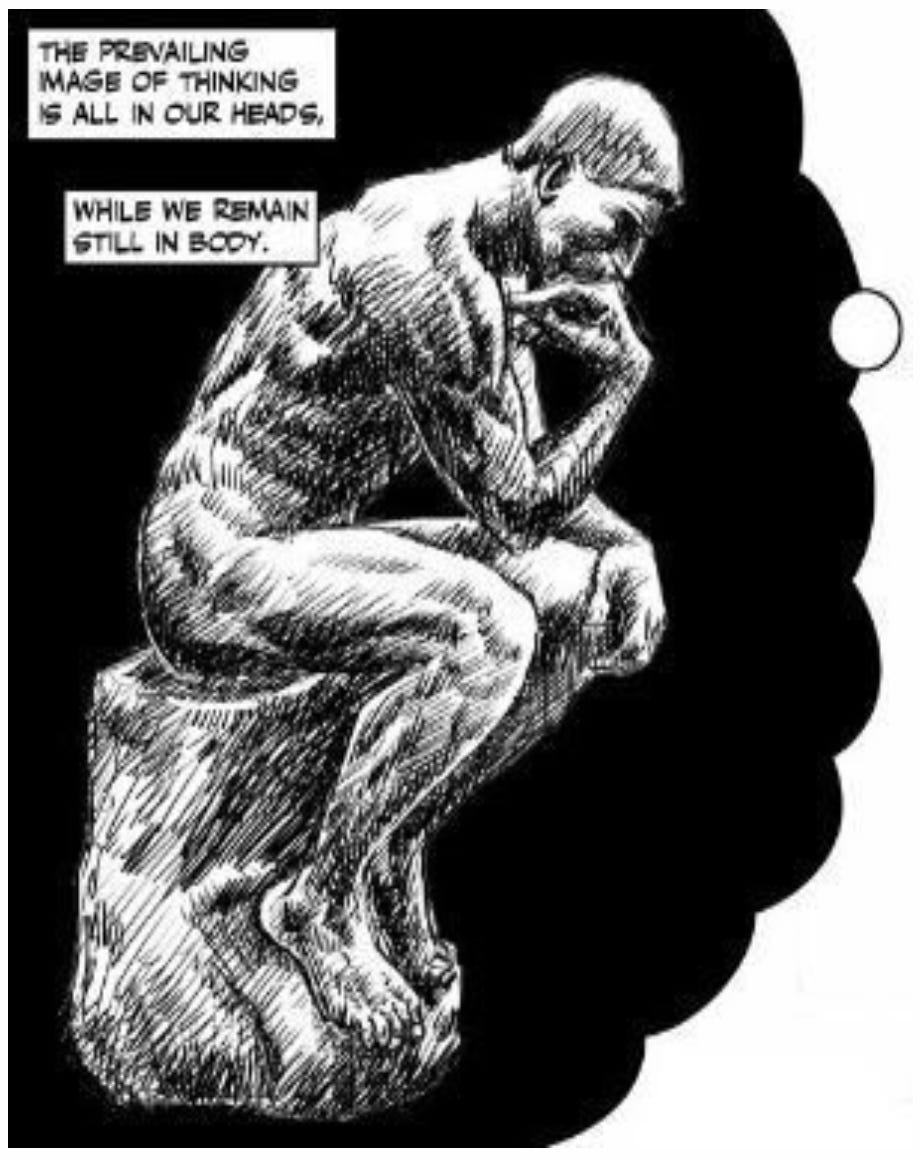
Sousanis’s constant intermingling of the textual and the visual is a key component to his creative process. In interview, he acknowledged that his work would have invariably taken on a different tone if he exclusively worked in one medium at a time rather than through his iterative, integrative, holistic process. Sousanis’s vibrant artistic and intellectual work stands in stark contrast to the more traditional, arguably more staid world of academic writing, which normally focuses on abstract thinking, described through sophisticated language. By seamlessly marrying text and image, complex abstractions of thought become clearly demarcated by letters and shapes on paper. As a result, Sousanis is able to transcend the limitations of both forms of communication to convey his message to a broader audience. Unflattening successfully acts as a hybrid text with a strong invitational quality—its academic theory, conveyed through text and visuals, transforms reading into a richer experience for all, especially for those shut out of post-secondary education.
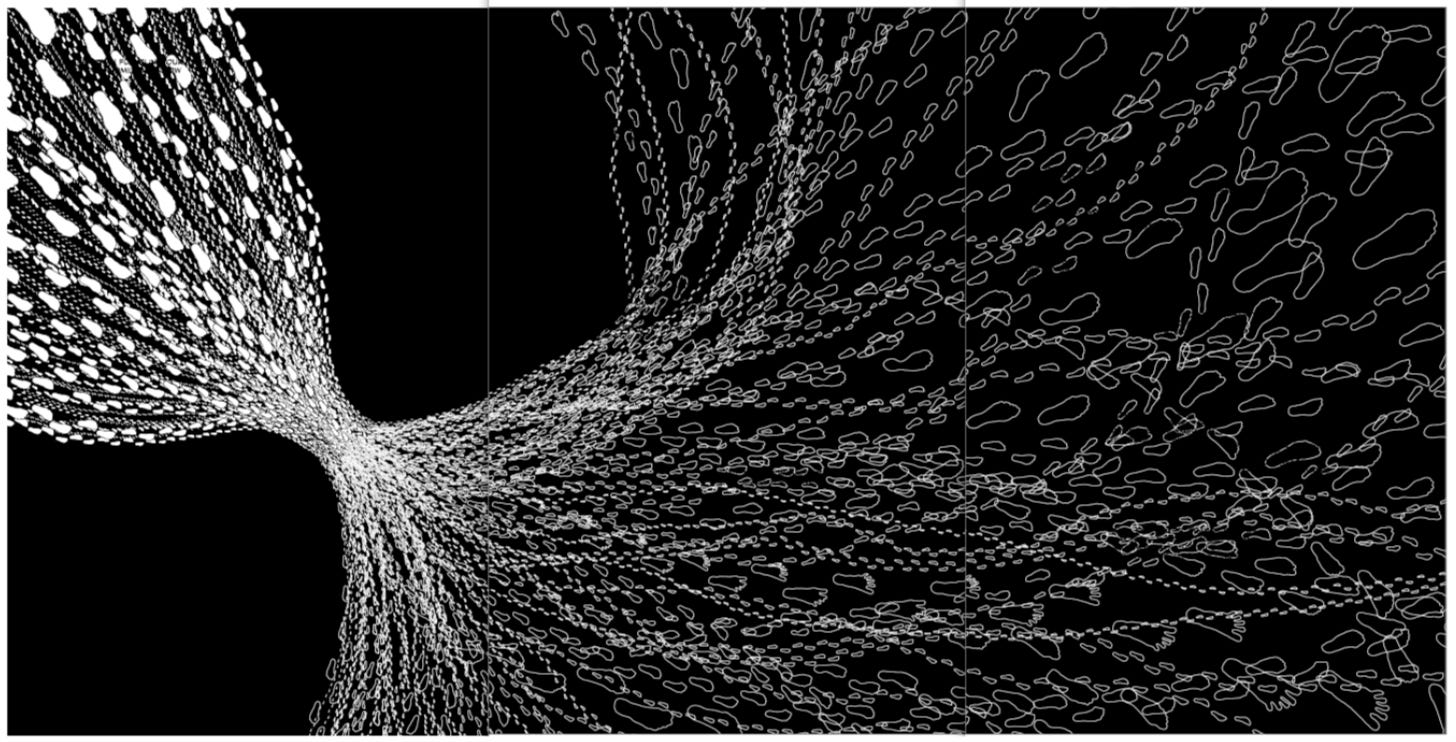
Unflattening is divided into ten sections. ‘Flatness’ introduces the process of flattening, the main theme of the book. ‘Flatland’ explores the implications of Edwin A. Abbott’s book of the same name (1884 / 1952), its two-dimensional inhabitants, and the need to push past the confines of these two dimensions. ‘The Importance of Seeing Double and Then Some’ encourages us stretch the dimensionality of our perceptions in all directions, including those in our imagination. ‘The Shape of Our Thoughts’ discusses the primacy of words—their privileged position in the world of ideas —as well as the importance of visuals beyond aesthetics or spectacle. ‘Our Bodies in Motion’ explores the physical activity of drawing that happens in a dynamic relationship with what has been rendered on the page. ‘The Fifth Dimension’ argues for our imaginations as a separate dimension, a site of transformation, and the frame within which multiple worlds can reside. ‘Ruts’ implores us to revisit John Dewey’s idea of ‘plasticity’ (1916 / 1966), which makes learning possible so that acquired habits do not constrict our flexibility. ‘Strings Attached’ makes an analogy with the Pinocchio tale, questioning our existence, compelling us to wonder in order to escape routine, defying the unknown puppet master who pulls our strings. ‘The Vectors’ section speaks of human nature as the interaction of competing forces perpetually in motion. Finally, ‘Awaking’ states that there is always more to discover, and that we should uniquely author our own paths.
Sousanis studied with Maxine Greene, arguably the most important educational philosopher since Dewey. Greene spent a lifetime advocating for the moral imperative of arts within traditional educational settings, such as public schools. By incorporating Greene’s sense of aesthetic urgency, Sousanis is also advocating for the fundamental role of the arts not only in education, but also in human development and self-actualization. On a broader metaphorical level, Sousanis intermingles images with text in a manner that turns these individual modes of expression, as well as the limits of the media, on itself. He effectively battles the flattening forces that limit the multidimensionality of humanity with a form that is, itself, limited to only two dimensions. Nick Sousanis’s Unflattening is ultimately an important contribution to the wider argument for the place of visual art in traditional academic research and discourse.
References
Abbott, E. A. (1994) 1952. Flatlands: A romance in many dimensions. Reprint, New York, NY: Dover.
Dewey, J. (1916) 1966. Democracy and education: An introduction to the philosophy of education. Reprint, New York, NY: Free Press.
Marcuse, H. 1991. One-dimensional man: Studies in the ideology of advanced industrial society. 2nd ed. Boston, MA: Beacon Press.
McCloud, S. 1993. Understanding comics: The invisible art. Northampton, UK: Tundra.